Intersectional Incoherence: Zainichi Literature and the Ethics of Illegibility

My book, available for preorder from University of California Press. (link) About the book: Intersectional Incoherence stages an encounter between the critical discourse on intersectionality and texts produced by Korean subjects of the Japanese empire and their postwar descendants in Japan, known as Zainichi Koreans. Arguing for intersectionality as a reading method rather than strictly a…

Read more Intersectional Incoherence: Zainichi Literature and the Ethics of Illegibility
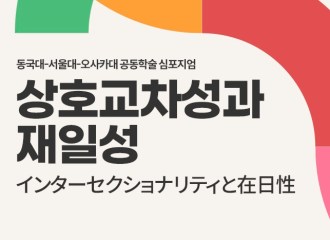
Intersectionality and Zainichiness

Special section of Ilbonhak (Dongguk University Institute for Japanese Studies). (link) This collection of articles was the outgrowth of an international symposium, “Intersectionality and Being Zainichi,” presented by the Osaka University Global Japanese Studies Education and Research Incubator, the Dongguk University Institute for Japanese Studies, and the Seoul National University Institute for Japanese Studies. Contributors…

Read more Intersectionality and Zainichiness

Implicated Reading: Medoruma Shun’s Me no oku no mori and the Ethics of Narrative Transmission

Article published in Asia-Pacific Journal: Japan Focus. (link) Abstract: This paper analyzes the animating potential of narrative in Medoruma Shun’s Me no oku no mori (In the Woods of Memory, 2009). The novel’s narrative structure embodies both the constant circulation of traumatic memories, particularly surrounding sexual violence, and the inevitable gaps in such memories. The text…

Read more Implicated Reading: Medoruma Shun’s Me no oku no mori and the Ethics of Narrative Transmission

Whose Korea Is It? Reading Zainichi Literature Intersectionally

Chapter published in The Routledge Companion to Korean Literature (edited by Heekyoung Cho). (link) Abstract: This chapter takes up the question “whose Korea is it” in order to unpack key differences between belonging and representation, as understood with respect to the increasingly expansive and transnational category of Korean literature. I argue that as the notion of…

Read more Whose Korea Is It? Reading Zainichi Literature Intersectionally

Zainichi Writers and the Postcoloniality of Modern Korean Literature

Chapter published in Routledge Handbook of Modern Korean Literature (edited by Yoon Sun Yang). (link) Abstract: This chapter argues that a critical examination of Zainichi literature sheds light on the postcolonial temporality of postwar Korean literature on the peninsula and in the Japanese diaspora. I argue that the diverging paths of Zainichi writers Kim Saryang, Chang…

Read more Zainichi Writers and the Postcoloniality of Modern Korean Literature

Representing Radical Difference: Kim Sŏkpŏm’s Korea(n) in Japan(ese)

Article published in positions: asia critique 27, no. 3: 499–529. (link) Abstract: This article considers the politics of representing “Korea” in Japanese-language texts, focusing specifically on the work of “Zainichi” writer Kim Sŏkpŏm (1925–). The author begins by identifying parallels between what Kim calls “the spellbinding of language” (kotoba no jubaku) and the unresolved debate…

Read more Representing Radical Difference: Kim Sŏkpŏm’s Korea(n) in Japan(ese)

Literature of the Concealed Home: Passing and Imperial Periphery in Yamanokuchi Baku’s Prose Fiction

Article published in Azalea: Journal of Korean Literature and Culture 12: 301–333. (link) Abstract: This article, part of a special section of Azalea on “The Politics of Passing in Zainichi Cultural Production,” examines the complex relations among Okinawans, Koreans, and other colonial subjects within the Japanese empire. In it, I consider the concept of “furusato”…

Read more Literature of the Concealed Home: Passing and Imperial Periphery in Yamanokuchi Baku’s Prose Fiction

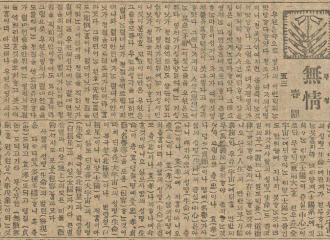
Queer(ing) Language in Yi Kwangsu’s Mujŏng: Sexuality, Nation, and Colonial Modernity

Article published in Journal of Korean Studies 23, no. 1: 67-96. (link) Abstract: This article presents a queer reading of Mujŏng (Heartless, 1917) by Yi Kwangsu (1892–1950). Often touted as Korea’s first modern novel by virtue of its innovative vernacular language and concern with themes of individual subjectivity, this text illuminates the tension between the diverse…

Read more Queer(ing) Language in Yi Kwangsu’s Mujŏng: Sexuality, Nation, and Colonial Modernity

Silent Transactions and Transactional Silences in Contemporary Japanese Literature and Media

Special session organized for Modern Language Association, Chicago, Illinois, January 3-6. Abstract: If textual transactions refer to the mutually constitutive arrangement of texts mediating and mediated by bodies, then sound can scarcely be anything other than such a transaction. Indeed, the emergent “sonic turn” in the humanities is motivated in part by renewed questions of ontology,…

Read more Silent Transactions and Transactional Silences in Contemporary Japanese Literature and Media